I just got back from a competition that some of our athletes competed in, and I always leave events like that with the same thought: we really do train differently.
Not because we are trying to be fancy. Not because we think every rep has to look perfect. And definitely not because every person in our gym moves the same way. They do not.
We train differently because we are a coaching facility, and that means our coaches coach.
That may sound obvious, but it is not always what happens in gyms. At Chaka, we hold our members to the standard of each movement. If someone cannot meet that standard because of mobility, strength, coordination, injury, or experience level, we adapt the movement. We scale it. We modify it. We meet the athlete where they are.
But the important part is this: our athletes know what the standard is.
They know what a rep is supposed to look like. They know what range of motion is expected. They know why we ask for certain positions. They know that if we scale something, it is not because they are doing “less.” It is because we are finding the version that allows them to train well, move safely, and still get the intended stimulus of the workout.
Watching our athletes compete and hit the standards was awesome. They were able to move through the tasks in front of them with confidence because they understood what was being asked of them. They were not guessing. They were not confused. They knew how to execute.
What was even more telling was watching other athletes struggle through the workouts, not because they were not working hard, but because they clearly did not understand the movement standard. In some cases, they were missing reps over and over again. In other cases, they were doing movements in a way that made the workout harder, less efficient, or less safe.
And honestly, that is frustrating to see.
Because those athletes have a coach somewhere. They have someone who should be teaching them what a good rep looks like. They have someone who should be explaining the difference between moving fast and moving well. They have someone who should be helping them understand that standards are not just a competition thing. They are a training thing.
Movement standards matter.
They matter for safety. They matter for execution. They matter for progress. They matter because when you understand the standard, you understand what you are training toward.
That does not mean every athlete will move the same. Some people will squat below parallel easily. Some will need a box, a target, or a different variation. Some people will do toes to bar. Some will do knee raises, V-ups, or another core option. Some people will jump. Some will step. Some will lift heavy. Some will use an empty barbell.
The standard gives us the goal. Scaling gives us the path.
That is the difference.
Scaling is not ignoring the standard. Scaling is respecting the standard enough to choose the right version for the athlete in front of us.
As coaches, our job is not to let people just survive the workout. Our job is to teach, guide, correct, adapt, and help each person move better over time. Sometimes that means slowing someone down. Sometimes that means taking weight off the bar. Sometimes that means changing the movement completely. Sometimes that means saying, “Not yet, but we are working toward it.”
That is coaching.
And for the athlete, it creates confidence. You know what is expected. You know why you are doing what you are doing. You know that when you walk into a competition, a class, or any workout, you have been taught how to move with purpose.
I was really proud watching our athletes this weekend. Not just because they worked hard, but because they represented what we care about every day inside the gym.
Effort matters. Intensity matters. Community matters.
But movement standards matter too.
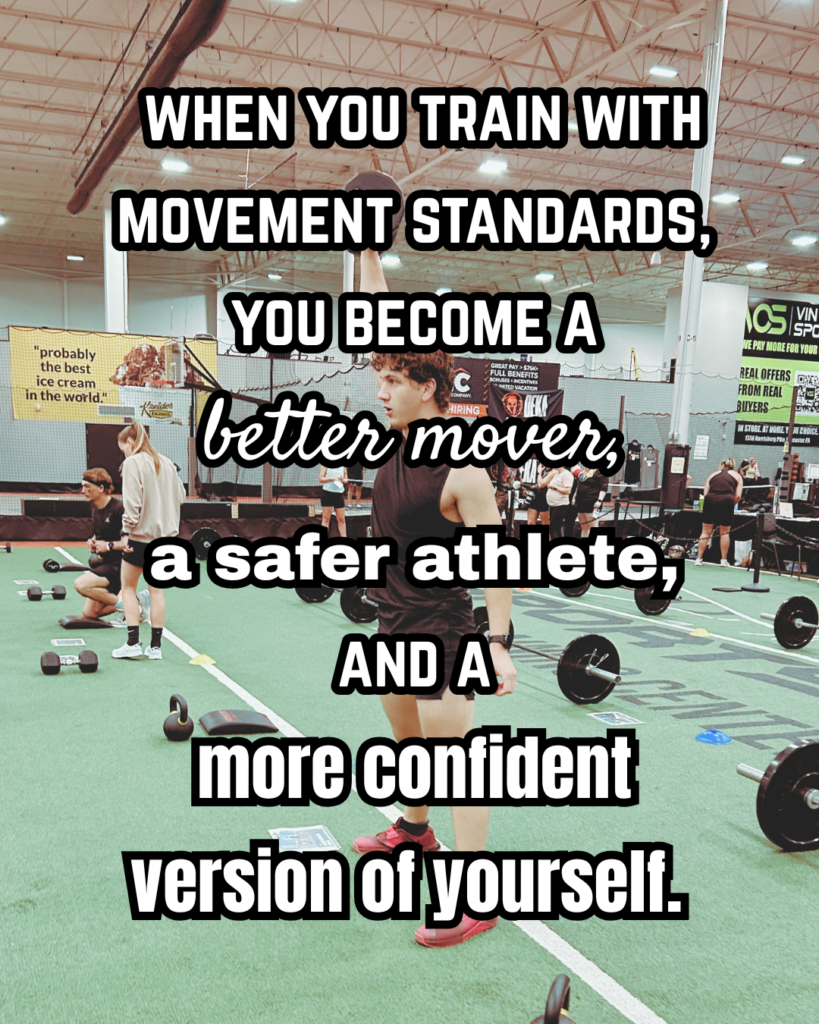
And when you train with standards, you do not just get better at workouts.
You become a better mover, a safer athlete, and a more confident version of yourself.