Hanging from a pull-up bar seems pretty simple. You grab the bar, pick your feet up and hang.
Sounds simple, right?
For some people it is. For others, not so much.
But hanging actually tells us quite a bit about our physical capacity.
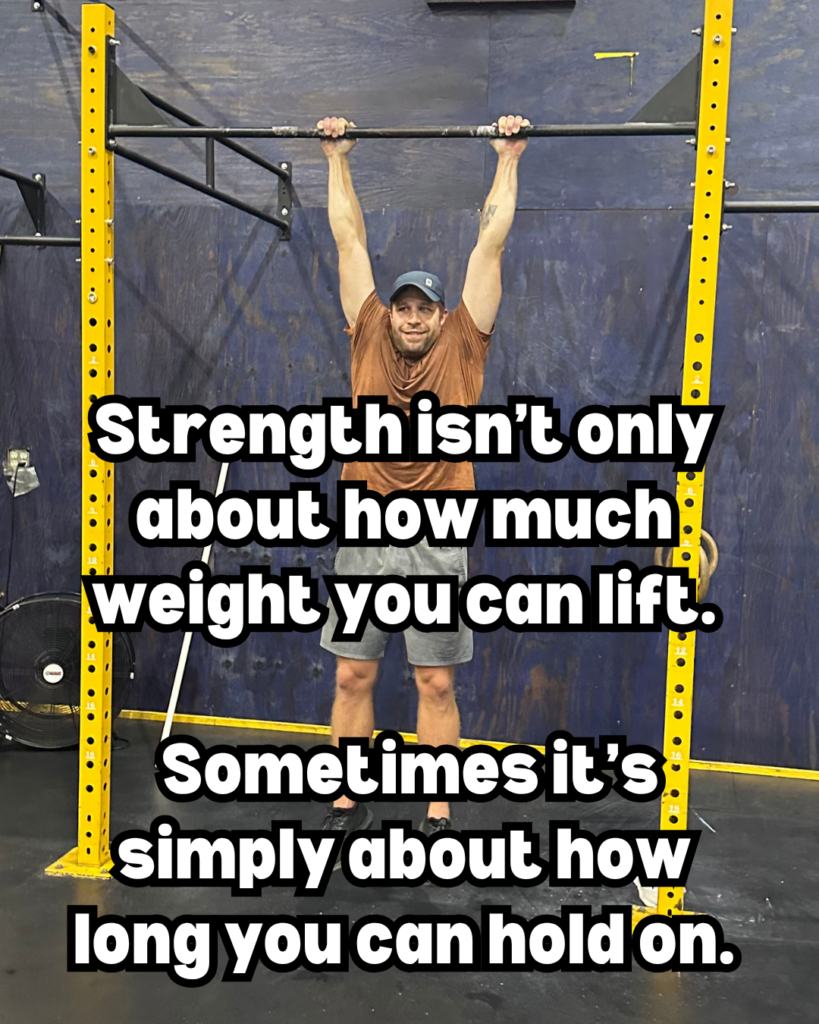
A dead hang is when you hang from a bar with straight arms and your feet off the ground. You are supporting 100% of your bodyweight through your hands, forearms, shoulders, and upper body.
You need grip strength, shoulder stability and muscular endurance. You also need enough strength to simply keep yourself attached to the bar.
Those are all things worth maintaining as we get older.
There isn’t an official medical standard that says a healthy adult should be able to hang for a certain amount of time, but as a general fitness benchmark I like this:
Less than 10 seconds — something worth working on
10–30 seconds — building a base
30–60 seconds — a solid goal for a healthy adult
60+ seconds — very good grip endurance
90+ seconds — excellent
2 minutes — that’s an impressive hang
Your age, bodyweight, training history, hand size, the thickness of the bar and previous injuries can all affect your time, so don’t get too caught up comparing yourself to someone else.
What I really like about hanging is how easy it is to see progress.
Maybe you meet me at a Kickstart session and can hang for 3 seconds. Two months later you can hang for 35.
That’s progress.
It isn’t complicated. You don’t need a fancy test or a bunch of numbers. You can simply see that your body is getting stronger.
The better question is really: can you hang, and is your hang getting better?
Grip strength matters more than most people realize
This is where hanging gets interesting.
Yes, I said interesting…
Research involving millions of adults has found a connection between grip strength and long-term health. People with weaker grip strength were more likely to have health problems and a higher risk of dying earlier. People with greater grip strength tended to have better long-term health.
That doesn’t mean grip strength determines how healthy you are.
It also doesn’t mean hanging from a bar is some magical longevity exercise or that adding 20 seconds to your hang is going to add years to your life.
It just shows us, once again, that staying strong as we get older matters.
Grip strength happens to be one very simple way researchers can measure that.
Hanging is more than grip
When you’re hanging from a bar, your hands may be the first thing you notice, but they’re not doing all the work.
You are asking your body to support its own weight.
You’re using your grip, shoulders and upper back and learning to control your own bodyweight.
And to me, that’s really the bigger picture.
We want to stay capable.
We want to be able to hold things, carry things, pull, push, climb, get ourselves off the floor and control our own bodies for as many years as possible.
That is physical independence.
What if you can’t hang yet?
Then we work on it.
You don’t avoid the bar because you can’t hang for 30 seconds yet. You scale it.
That might mean keeping your feet lightly on the floor or on a box. It might mean using your legs to take some of your bodyweight. Maybe you do several short hangs instead of one long one. Farmer’s carries and other grip work can help too.
Maybe today you can hang for 3 seconds.
Then 8.
Then 15.
Then 30.
That’s the point.
Strength isn’t only about how much weight you can lift.
Sometimes it’s simply about how long you can hold on.